
Practice what you preach: Why Leiden University should suspend all collaborations with Israel


The Executive Board has decided not to implement the recommendation of the Committee on Human Rights and Conflict Areas to suspend all collaborations with Israel, failing to uphold the values of human rights and international justice they claim to defend.
On 2 April 2026, the Committee on Human Rights and Conflict Areas presented its advisory report regarding institutional research collaborations of Leiden University with partners in Israel to the Executive Board. The recommendation is clear: 1) to suspend 11 of the 12 current collaborations with Israeli partners until further notice and to terminate 1, and 2) not to enter into any new institutional research collaborations with partners in Israel until further notice. The Executive Board has adopted the second recommendation, but it has declined to follow the advice on suspension. Instead, it proposes ‘a more nuanced approach’: for decisions on current collaborations ‘it will look expressly at project-level activities.’
We believe that the Executive Board’s approach is difficult to reconcile with the advisory report, and, more importantly, with the issues of human rights and academic integrity. We come to this conclusion after an analysis from four different angles: the process of decision-making, the argument of reputational risk, the related questions of solidarity and academic freedom, and a historical perspective.
Decision-making and trust
As last year’s Employee Experience Survey clearly showed, there is a lack of trust in the way decisions are made at our university. The Executive Board’s response to the Committee on Human Rights and Conflict Areas’ advice on research collaborations with Israel seems to exemplify these issues.
In principle, the idea is commendable: let a commission of Leiden’s own experts on human rights and conflict areas, such as a professor in political philosophy and a senior university lecturer in international legal studies, produce an advice based on their knowledge and expertise. In this way, the university places its trust in us – the researchers and teachers who are at its core.
But this only works if the advice is accorded its due weight. The Executive Board, however, has decided not to implement the committee’s recommendation to suspend or terminate all current collaborations with Israeli universities. Some of the reasons on which the Executive Board bases its approach were outside the scope of the advice committee, such as the university’s reputation – an argument that will be discussed below. But the Board also disputes many of the committee’s ethical deliberations. For example, the Board writes that it ‘deems it necessary to give more weight to the third factor within the committee’s framework – the nature of the activity – in decisions about individual projects.’ The committee has already taken the nature of these activities into account, but has judged that this does not outweigh the moral risk of collaborations. Likewise, the Executive Board overrules the committee’s considerations on science diplomacy and the humanitarian impact of suspending collaborations.
The Board’s proposed approach creates the impression that expert consultation serves primarily to legitimize decisions already made, rather than to inform them. Unlike the committee’s report, which is well-researched and sourced (as one would expect of academics), the Board’s response is brief and does not cite relevant scholarly research on the topic. Nevertheless, the Board seems to feel compelled to place its own judgements over those of the experts it has appointed. Not only does this contribute to the perception that decisions are made by the top and merely communicated to the bottom, the procedure also seems to lack the scholarly rigour one would expect of a university.
Reputational risk
The Executive Board foregrounds reputational risk as a reason not to withdraw from ongoing collaborations. It warns that patient organisations, medical professionals, and consortium partners may question Leiden's reliability, and suggests that continued participation could help uphold ethical standards from within. What is missing from this analysis is the reputational risk of maintaining institutional ties with partners that the Board’s own committee has found to be entangled with systematic violations of international humanitarian law. Reputation cuts both ways, and we believe the latter argument carries more weight.
The Board’s decision not to enter into new institutional partnerships reflects a growing European trend, and we recognise this step. Ghent University already has withdrawn from Horizon Europe consortia involving Israeli partners, with the European Commission approving its exit without sanctions. Notably, the European Commission itself has proposed a partial suspension of Israel's association with Horizon Europe. As more institutions act, those that do not may increasingly be seen as reputationally compromised precisely because they maintain ties others have severed on human rights grounds. If the EU proceeds with suspension, Leiden will have waited for external regulations to do what others chose to do based on principle.
The committee’s findings are unequivocal. They document systematic violations of international humanitarian law and identify indications of genocide. In that context, maintaining institutional ties is not neutrality. It is a choice: one for which institutions will ultimately be judged. The Executive Board weighs the reputational costs of suspending collaborations, but not the reputational costs of continuing them despite the conclusions of its own expert committee. The evidentiary record is extensive, and the International Court of Justice has already found the claim of genocide to be plausible. Under these circumstances, the reputational risk of being reliable seems trivial as continuing these collaborations despite the committee’s findings will ultimately constitute the greater institutional failure.
Solidarity and academic freedom
As discussions around the budget cuts in higher education have already shown, solidarity is easy to preach, but harder to put into practice. Moreover, solidarity is a political choice; solidarity with one group can come at the cost of another. In the discourse on a boycott of Israeli institutions, solidarity with Palestine is often contrasted with academic freedom. In May 2021, when a group of Dutch scholars called for a boycott, Hester Bijl, the Rector Magnificus at the time, stated on Twitter: ‘Leiden is a bulwark of freedom, where freedom of opinion is cherished. We stand behind inclusivity and social safety for those giving their opinion. Calls for a boycott do not form a part of that.’
But what about the academic freedom of Palestinian scholars? The advisory committee has used academic freedom as a primary focus, but this leads to a different conclusion than that of Bijl: ‘The Leiden principle of academic freedom is called into question by collaboration with partners that contribute to the structurally unbalanced power structure that results in the systematic restriction of Palestinian academic freedom.’
In the Board’s response, however, a boycott and academic freedom are again presented as if they are in opposition with each other; the Board speaks of ‘tension between institutional responsibility for human rights, on the one hand, and the value of academic freedom and international cooperation on the other’. The Board also emphasises the importance of continued connection with ‘academics and staff in Israel and in the occupied Palestinian territories who are committed to human rights, dialogue and just peace’. It should be noted that a full boycott does not prohibit this, as it only concerns institutional ties and still allows for individual collaborations.
What is to be applauded in the Executive Board’s approach, is the intention to support Palestinian academics and institutions through emergency grants or reconstruction programmes for academic infrastructure. ‘Solidarity with our colleagues in that region,’ states the Board, ‘is our guiding principle.’ But that solidarity does not materialise in a full boycott. Maintaining academic ties with Israeli institutions contradicts the principle of academic freedom. These partner universities are deeply intertwined with a system that has decimated Palestinian education, destroying over 97% of schools and universities in Gaza [1]. Continuing these collaborations prioritizes institutional ties over the survival of Palestinian academic life. If these collaborations pose too great a risk to start, the same risk applies to those already underway. Again, it seems that solidarity is easy to declare, but hard to practice.
Historical lessons
Which historical lessons can be learned from our own university when justice and freedom were at stake? Leiden University prides itself with Rudolph Cleveringa’s famous protest speech in 1940, in which he spoke out against the dismissal of his Jewish colleagues. He knew what was at stake, yet he did not remain silent. His act of courage has become deeply entrenched in the university’s self-narrative, a reminder of its commitment to freedom and liberation from oppression. The university’s creation story as a bastion of freedom from Catholic Europe, was later crowned by the motto Praesidium Libertatis.
This commitment to freedom has been used time and again to address human rights issues, invite scholars from oppressed regimes, give out honorary doctorates to remarkable people who fought for liberation. One such extraordinary figure was Nelson Mandela, who received an honorary doctorate from Leiden University in 1999 for his struggle against apartheid.
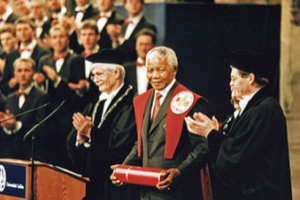
Mandela’s fight did not end after apartheid, but it became one of his lifelong missions to speak out against the injustices committed by the Israeli state against the Palestinian people, in which he saw stark parallels with the apartheid system: ‘Having achieved our own freedom, we can fall into the trap of washing our hands of the difficulties others face. Yet we would be less than human if we did so’ [2]. After visiting Palestine many times, archbishop Desmond Tutu likewise observed that what was going on in Gaza was very similar to apartheid but much worse. His judicial adviser and international justice expert, Leiden professor emeritus John Dugard – who represents the historical South African case at the ICJ against Israel – echoes Tutu’s observation: ‘Israel’s occupation policy is very similar to that of South Africa back then, but worse. Much worse.’ Furthermore, Dugard observes the Western double standard vis-à-vis the Israeli case compared to South Africa’s case at the time [3].
However laudable the committee’s advice is as institutional recognition at Leiden University that Israeli institutions are structurally complicit in acts of genocide committed against the Palestinian people, not suggesting a full boycott means that the committee stops short of fully addressing the consequences of its findings. What is much worse, is the Executive board’s decision not to follow the advice of its own committee. It echoes the Dutch State’s neglect of international law [4].
In 1978, led by students, Leiden University severed all ties with South Africa’s apartheid regime. Over the past two years, we have seen the reverse: the pro-Palestinian movement has been criminalized, ‘conspicuous’ students have been illegally spied upon, and counter voices have been silenced. After Russia’s invasion of Ukraine, it took the university 8 days to cut all ties. While the latter decision was informed by the Dutch government, the university has long prided itself on being a bastion of and for freedom. Yet the response to the current situation, in which the university's own expert committee has recommended suspension, has been to defer, delay, differentiate, and develop a framework. The contrast speaks for itself.
History rarely condemns institutions for acting too early in defence of fundamental rights. More often, it condemns them for waiting until the moral and legal reality could no longer be denied. ‘One day, [when] everyone will have always been against this’ [5], which narratives of freedom and justice will Leiden University have to defend its lack of accountability?
Conclusion
In choosing to not suspend all collaborations with Israeli universities, we believe that Leiden University fails to uphold the values of human rights and international justice they claim to defend. Across each of the dimensions examined in this statement – decision-making, reputational risk, solidarity, and historical precedent – the Executive Board’s position contains the same contradiction: it acknowledges the gravity of the situation, but declines to act on that acknowledgement. We therefore urge the Executive Board to implement the committee’s recommendation and suspend all collaborations identified in its report, rather than postponing action pending a framework that does not yet exist. Not because doing so is without cost, but because the cost of inaction will prove to be the greater one.
Note: these statements do not necessarily reflect the opinions of all members of the Young Academy Leiden.
[1] Wind M., (2024). Towers of Ivory and Steel: How Israeli Universities Deny Palestinian Freedom. London: Vers. ISBN-13: 9781804291740
[2] Sello Hatang and Sahm Venter (eds). 2017. Mandela. Nelson Mandela by Himself. The Authorised Book of Quotations. Auckland: MacMillan & PQ Blackwell.
[3] Interview in Trouw, 20 January 2026, Aletta André. Translated from Dutch.
[4] Article 1 of the UN Genocide Convention stipulates that State parties have a duty to prevent and punish genocide, paras. 425, 426 and 427.
[5] Omar El Akkad. 2025. One Day, Everyone Will Have Always Been Against This. Penguin Random House.



0 Comments